Program template
A 4-day upper lower split for strength, with the rules to run it
Most split templates stop at the exercise list. This one adds what to do when readiness drops, a lift hurts, or the client misses a day.
By RaiNGE product teamUpdated 7 min read
Written for coaches running a four-day strength block for intermediate clients.
Jump to the weekly templateShare one client's goal, experience, and equipment, and RaiNGE emails you a sample session draft to review. Get a sample workout
On this pageWho this split fits
Who this split fits
The split suits intermediate clients: six or more months of consistent lifting, sound squat, hinge, and press technique, and a schedule that holds four sessions a week. Sessions run 60-75 minutes. Newer clients should start with the 12-week beginner strength program, and clients with only dumbbells should use the dumbbell only workout program.
The weekly template
Train Monday, Tuesday, Thursday, and Friday, or any layout that avoids four days in a row. The A days carry the heaviest work. The B days change the lifts and add reps to spread fatigue and skill practice across the week.
4-day upper lower split, one week
Main lifts at RPE 7-8, leaving 2-3 reps in reserve. Accessories at RPE 8. Rest 2-3 minutes on main lifts and 60-90 seconds on accessories.
Monday
Upper A
Horizontal press and pull
- Barbell bench press
- 4×6-8
- Barbell bent-over row
- 4×6-8
- Incline dumbbell press
- 3×8-10
- Lat pulldown
- 3×8-10
- Dumbbell lateral raise
- 3×12-15
Tuesday
Lower A
Squat strength and the hinge
- Barbell back squat
- 4×5-6
- Romanian deadlift
- 4×6-8
- Leg press
- 3×8-10
- Lying leg curl
- 3×10-12
- Pallof press
- 2×10/side
Thursday
Upper B
Vertical press and pull, dumbbell volume
- Standing barbell overhead press
- 4×6-8
- Pull-up (assisted if needed)
- 4×6-8
- Dumbbell bench press
- 3×8-10
- Chest-supported dumbbell row
- 3×8-10
- Rear delt fly
- 3×12-15
Friday
Lower B
Pull strength and single-leg work
- Trap bar deadlift
- 4×5-6
- Barbell front squat
- 3×6-8
- Barbell hip thrust
- 3×8-10
- Front-foot elevated split squat
- 3×8-10/side
- Standing calf raise
- 3×12-15
When to adjust
- Every set at the top of the range, RPE 8 or less
- Add 2.5-5 lb next session
- Readiness check-in 60-69%
- Drop a set or cut load 5-10%, and keep the session
- Readiness check-in under 60%
- Drop a set, cap effort at RPE 7, and lengthen rest
- Pain 3-5/10 on a lift
- Cut load or range
- Pain 6-7/10
- Stop that movement and use a conservative alternative
- Pain above 7/10, or sharp, worsening, radiating, or unfamiliar
- Stop loading and refer out
- Equipment unavailable
- Use the substitution table below
How to progress the main lifts
Use double progression inside each rep range. Keep the load until every set reaches the top of the range at RPE 8 or less, then add 2.5-5 lb and return to the bottom of the range. Accessories follow the same rule, often one rep per set at a time.
Example: bench press 4×6-8 at 185 lb. In week 1 the client gets 8, 7, 7, 6. Week 2 gets 8, 8, 7, 7. Week 3 gets 8, 8, 8, 8 at RPE 8, so week 4 moves to 190 lb and starts again near 6 reps per set.
Adjust for readiness, pain, and missed days
A four-day split only works if the client recovers from all four sessions. When recovery falls behind, keep the session on the calendar and lower the dose: lighter top sets, a capped RPE, or a technique day.
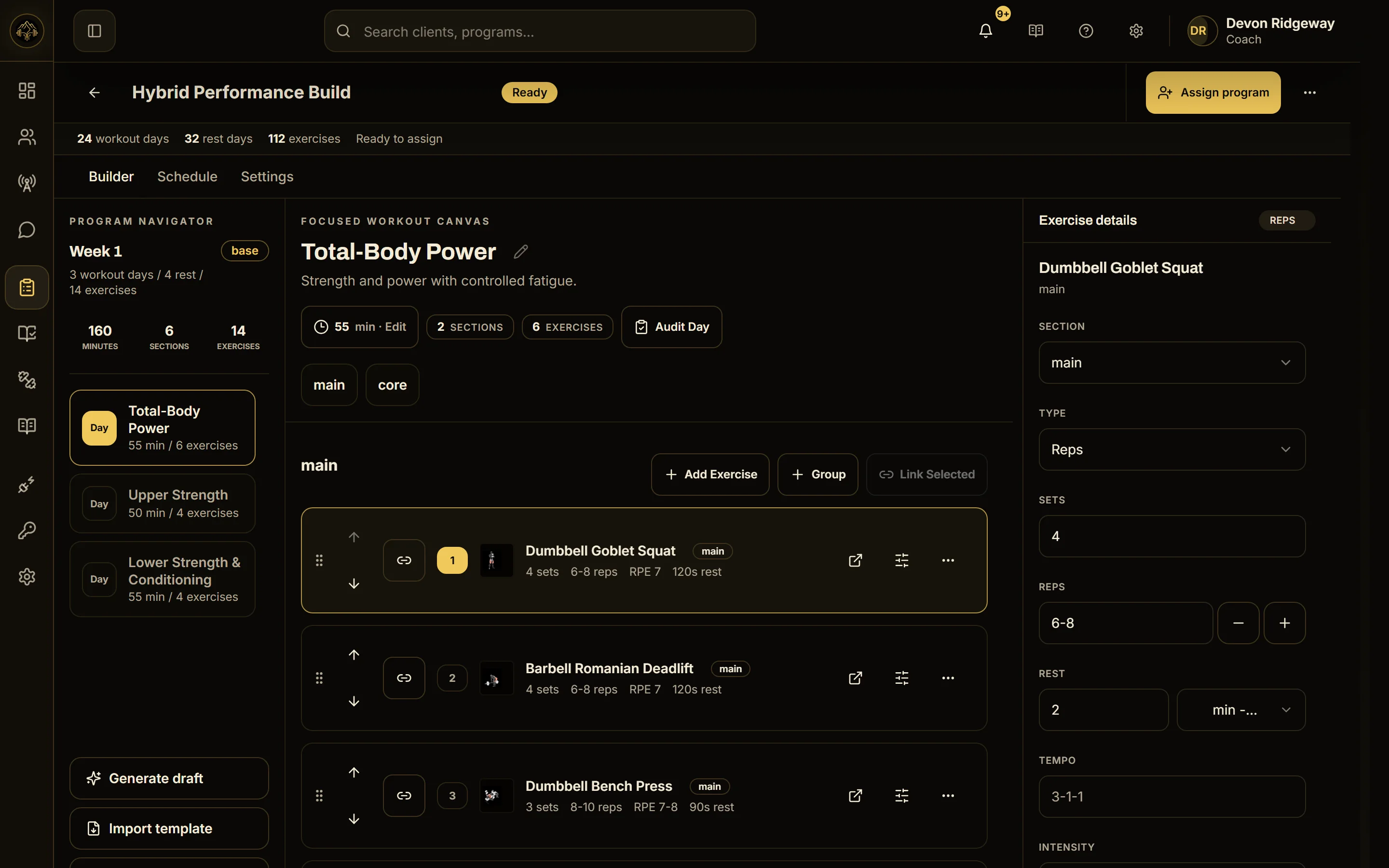
In RaiNGE, coach-approved changes to sets, reps, rest, and intensity notes apply to the assigned workout as one change that can be reverted, and the athlete is notified after it succeeds. Dropping a set and lowering the intensity note on a low-readiness day is one edit to the session the client already has.
Swap exercises without losing the slot's job
Swap by movement pattern and training goal so the replacement does the same job. Some lifts do not swap cleanly: a hip thrust keeps the RDL's hip extension but loses the long-hamstring position, so pair it with a curl. The Romanian deadlift alternatives guide covers the hinge slot, and trap bar deadlift vs deadlift covers the Friday pull.
Common questions
Is a 4-day upper lower split good for building muscle?
Yes. It trains each muscle twice a week, which suits muscle gain as well as strength. To bias the block toward size, move the main lifts to 3×8-12, add one set to each accessory, and keep most sets 1-2 reps short of failure. Expect slower progress on the heavy lifts while you do.
Can I run an upper lower split on three days a week?
Yes, by rotating. Week 1 runs Upper, Lower, Upper and week 2 runs Lower, Upper, Lower, so each half trains three times every two weeks. Each session comes round less often, so progression slows. For most three-day clients, full-body sessions are simpler to run and to track.
Where does conditioning fit in a 4-day upper lower split?
Add two or three short pieces after the upper days or on rest days: 10-20 minutes on a bike or rower at an easy to moderate pace. Keep hard intervals away from the day before Lower A or Lower B so they do not cut into squat and deadlift performance.
How long should a client stay on this template?
Usually 8-12 weeks with the same main lifts, as long as double progression keeps adding load. Rotate accessories every 4-6 weeks if a joint gets irritated or the client loses interest. When the main lifts stall through two lighter weeks, change the rep ranges or the lift variations for the next block.